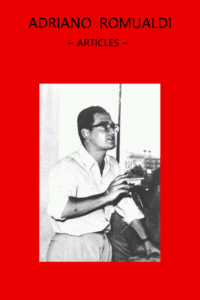
Adriano Romualdi
“Adriano Romualdi (Forlì, 9 December 1940 – Rome, 12 August 1973) was an Italian historian, essayist, politician and journalist.
He was the son of the president of the Italian Social Movement, Pino Romualdi.
He graduated from Sapienza where he was a pupil of Del Noce and De Felice, with a thesis on the German conservative revolution with Renzo De Felice and Rosario Romeo.
He was involved in a case of political violence: on February 13, 1964, he was driving a Fiat 600, together with neo-fascists Paolo Pecoriello and Flavio Campo, who attacked a group of people accompanying Pier Paolo Pasolini and who were defending him from a fascist ambush. Pasolini chose not to file a complaint.
He was strongly influenced by Julius Evola, of whom he became his favourite pupil, but attracted the criticism of his father. He wrote an authorized biography of Evola published in 1966.
He published articles and books on Plato, Friedrich Nietzsche, Oswald Spengler, Pierre Drieu La Rochelle, Robert Brasillach, Adolf Hitler and dealt with Nazism and Fascism, interpreted as a purely European phenomenon rather than a national one (a topic to which he dedicated his last book, published posthumously and incomplete), the German conservative revolution and the Second World War. He also devoted extensive studies to the Indo-Europeans, which earned him the acclaim of James Devotus. From 1971 he was a university assistant in contemporary history with Giuseppe Tricoli at the University of Palermo.
Having become one of the leading figures of the radical right, he died at the age of thirty-two in a road accident in Rome on the Via Aurelia. His death raised suspicions that it had not been a trivial accident due to his hypothetical involvement in the Piazza Fontana massacre and with the secret services: he had in fact been indicated as the only person who could clarify fundamental circumstances on the relationship between Franco Freda’s Venetian cell and Guido Giannettini’s SID.”